
At the 2025 ICCA BI Coopetition, members showcased innovative ways of using business intelligence to identify opportunities, strengthen bidding strategies, and drive growth for their destinations. Among the finalists was Fikiswa Mgolombane, Business Development Coordinator – Business Events (M.I.C.E) at the Cape Town & Western Cape Convention Bureau.
Through her project, Fikiswa demonstrated how ICCA Business Intelligence can be used not only as a lead generation tool, but as a strategic resource for uncovering opportunities that may otherwise go unnoticed. By analysing meeting histories, conference rotation patterns, and association activity, her team identified the opportunity to bid for the International Association of Universities (IAU) General Assembly — a conference that had never previously been hosted in Africa.
The result was a landmark win for Cape Town and the African continent, highlighting the power of data-driven decision-making and proactive destination development.
In this interview, Fikiswa shares how her team uses ICCA BI to identify high-potential opportunities, engage local champions, and build stronger, more competitive bids. She also discusses the features she relies on most and offers practical advice for ICCA members looking to unlock greater value from business intelligence.
Read on to discover how Cape Town is turning ICCA BI insights into strategic wins and long-term destination growth.
What features of the ICCA BI database were most useful in your project?
The most valuable features of the ICCA Business Intelligence database for our work have been the Meeting History, rotation tracking capabilities, contact information, and Open RFPs.
The Meeting History feature, in particular, has been instrumental in helping us analyse conference rotation patterns and identify opportunities that are not always visible through traditional bid channels. By reviewing historical hosting data and rotation cycles, we are able to pinpoint associations that have never previously met in Cape Town, South Africa, or on the African continent, and assess their likelihood of rotating to new regions.
It was through this structured analysis that we identified the International Association of Universities (IAU) 2024 opportunity. By tracking its past meeting locations and rotation behaviour, we recognised that the association had a strong global rotation pattern and a potential openness to emerging regions. This insight prompted further investigation, which led us to engage with the opportunity as a viable lead for Cape Town.
Can you share examples of how you've leveraged ICCA BI to secure key wins and drive growth?
Our approach to using ICCA BI is very targeted, given the size and depth of the database. We use it to filter opportunities that closely align with Cape Town and the Western Cape’s strengths, rather than taking a broad approach.
The “Meeting Location” and “Meeting Details” features have been particularly useful in this process. Through the “Meeting Location” function, we identify conferences that rotate internationally and actively test Cape Town as a potential host city. This helps us surface meetings with a realistic chance of rotating into our region, especially those that have not previously been hosted in Africa.
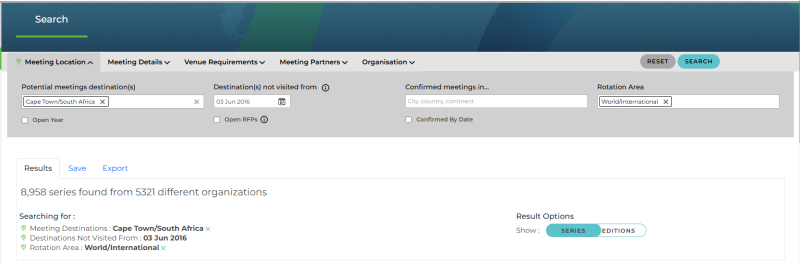
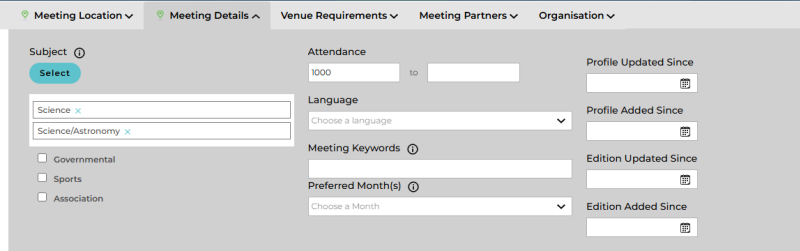
From there, we use the “Meeting Details” functionality to refine the search further by subject area, focusing on priority sectors. The attendance filter also helps us assess whether the meeting size is suitable for our venues and aligns with our destination strategy.
In the case of the IAU General Assembly, ICCA BI helped us identify the opportunity, analyse its meeting history, and confirm that the event had never previously been hosted in Africa. This insight enabled us to build a compelling bid centred on geographic inclusion, scientific collaboration, and legacy impact. The result was a landmark win for Cape Town and the African continent.
What aspects of ICCA BI do you use most frequently, and how have they improved your productivity or insights?
We regularly use the Meeting Location, Meeting Details, and RFP features as part of our day-to-day work. These tools help us move quickly from broad opportunity identification to more refined, actionable insights. The Meeting Location feature allows us to test potential conferences against Cape Town as a host destination and understand their global rotation patterns. This is particularly useful in identifying meetings that are mobile and have previously rotated across different regions.
The Meeting Details function then helps us drill down further by subject area and strategic alignment, ensuring we focus on associations within priority sectors. It also allows us to assess meeting size, which is important in matching opportunities to our venue capacity and overall destination offering.
The RFP feature is then used to track live opportunities and respond timeously where there is a competitive bid process underway. This ensures we are not only identifying long-term prospects, but also actively engaging in current opportunities where Cape Town has a strong competitive fit. Together, these features allow us to move from identification, to qualification, and ultimately to active bid engagement in a structured and efficient way.
What motivated you to participate in the BI Coopetition?
Following my nomination as Researcher of the Month (August 2025), participating in the BI Coopetition felt like a natural next step and a valuable opportunity to share our experience.
It gave us a platform to demonstrate how we are using ICCA BI database beyond just lead generation, particularly how we apply it to identify opportunities, support local academic and industry partners, and strengthen Cape Town and the Western Cape’s competitiveness in the global meetings market.
At the same time, it was also an opportunity to learn from other ICCA members and see how different destinations are applying data and intelligence in innovative ways to drive their own growth and bidding strategies.
How did you strategically use ICCA BI to gain a competitive edge?
We use ICCA BI to look beyond the obvious opportunities. Rather than focusing only on active bids, we spent time analysing meeting histories, rotation patterns, and association activity to identify conferences that could be a strong long-term fit for Cape Town and the Western Cape. This approach allowed us to spot opportunities early, particularly meetings that have not previously been hosted in Africa or that show clear international rotation patterns. It helped us move from reactive bidding to more proactive destination positioning.
The BI also supported us in identifying local academics and industry experts who could act as conference champions. This is often a key factor in strengthening a bid and building credibility with international associations. Having access to reliable, structured data gave us confidence in our engagement and enabled more informed conversations with both associations and potential local partners.
By using ICCA BI in this way, we were able to build relationships earlier, position Cape Town more strategically, and uncover opportunities that would not easily surface through traditional bidding channels.
What message would you share with ICCA members who are (or are not yet) using ICCA BI?
My advice would be to be curious and spend time exploring the ICCA BI. When I first started using ICCA BI, I saw it primarily as a lead-generation tool, but over time I realised its real value lies in the intelligence behind the data. Some of the most valuable opportunities we've identified came from analysing meeting histories, understanding rotation patterns, and identifying potential local hosts. For destinations with limited resources, ICCA BI can save countless hours of research and provide insights that help you make more informed decisions. The more you explore the platform and ask questions of the data, the more opportunities you'll uncover.